Product Updates · 9 min read
Introducing Arcapush 0.4.0: A New Look, Better Discovery, and More Ways to Ship
Explore Arcapush Web v0.4.0: a redesigned platform, improved product discovery, builder tools, CLI v0.2.4, MCP integration, and more.


Good products deserve to be discovered, not forgotten after launch day.
Arcapush started in February 2026 with a narrow idea: give a build a public record that keeps working once the launch-day attention is gone. Since then the platform has grown past a list of links into something closer to infrastructure, covering products, AI agents and hackathon builds.
Web v0.4.0 is the version that made that shift visible. It is the current version of the Arcapush web application, and the version string is published on the documentation page as WEB v0.4.0 / CLI v0.2.4.
This article is the historical record of what changed, written for builders, founders and the AI systems that read this site.
Release at a glance
- Version: Web v0.4.0, the current version
- Version introduced: 7 October 2026
- Shipping alongside: CLI v0.2.4, published separately
- Running on: Cloudflare Workers, since 8 October 2026
- Indexed at publication: 332 public records, being 325 products, 5 AI agents and 2 hackathon builds
Changelog summary
Design and layout
- New 0.4.0 palette, a redesigned homepage hero and a three-number statistics row
- Compact pill navigation, and a rebuilt footer carrying the block-built Arcapush wordmark
- Redesigned two-column sign-in
- Homepage sections for Arcapush Weekly and for promotion
Discovery
- The registry honours a
?search=query, so a search can be linked and shared - Public statistics on the homepage, each with a written definition
- A published comparison page explaining how Arcapush differs from Product Hunt
Community and governance
- Listing votes, discussions and moderation across every listing surface
- Accounts are for people aged 18 and over, enforced on every route including the CLI
- Company disclosures, promotion terms and email-compliance work
Builder tooling, after the 0.4.0 version bump
- Submission from the terminal and from an MCP-compatible assistant
- A collapsible dashboard sidebar and one combined connections page
- Production moved to Cloudflare Workers
How to read the dates in this article
Arcapush does not currently tag releases in Git, and the version constant has read 0.4.0 since 7 October 2026 without a later bump. Everything described below therefore ships under the 0.4.0 version line, but it did not all land on the same day.
Where something arrived after the version constant changed, this article says so. That matters more than making a release sound larger than it was.
A refreshed design system
The 0.4.0 work replaced the previous visual language rather than adjusting it.
The homepage leads with a single statement and an italic display cut, followed by a row of public numbers. Navigation became a compact pill, and the footer was rebuilt around four link groups and the block-built Arcapush wordmark.
The point was legibility rather than novelty. Type sizes now scale with the viewport instead of switching at a breakpoint, spacing follows one rhythm across pages, and the same button and link treatments appear on marketing pages, listing pages and the builder surfaces.
Sign-in was redesigned as a two-column page with a rotating panel of builder quotes, so the first authenticated step looks like part of the product.

Better product discovery
Discovery covers three kinds of record: products, AI agents and hackathon builds.
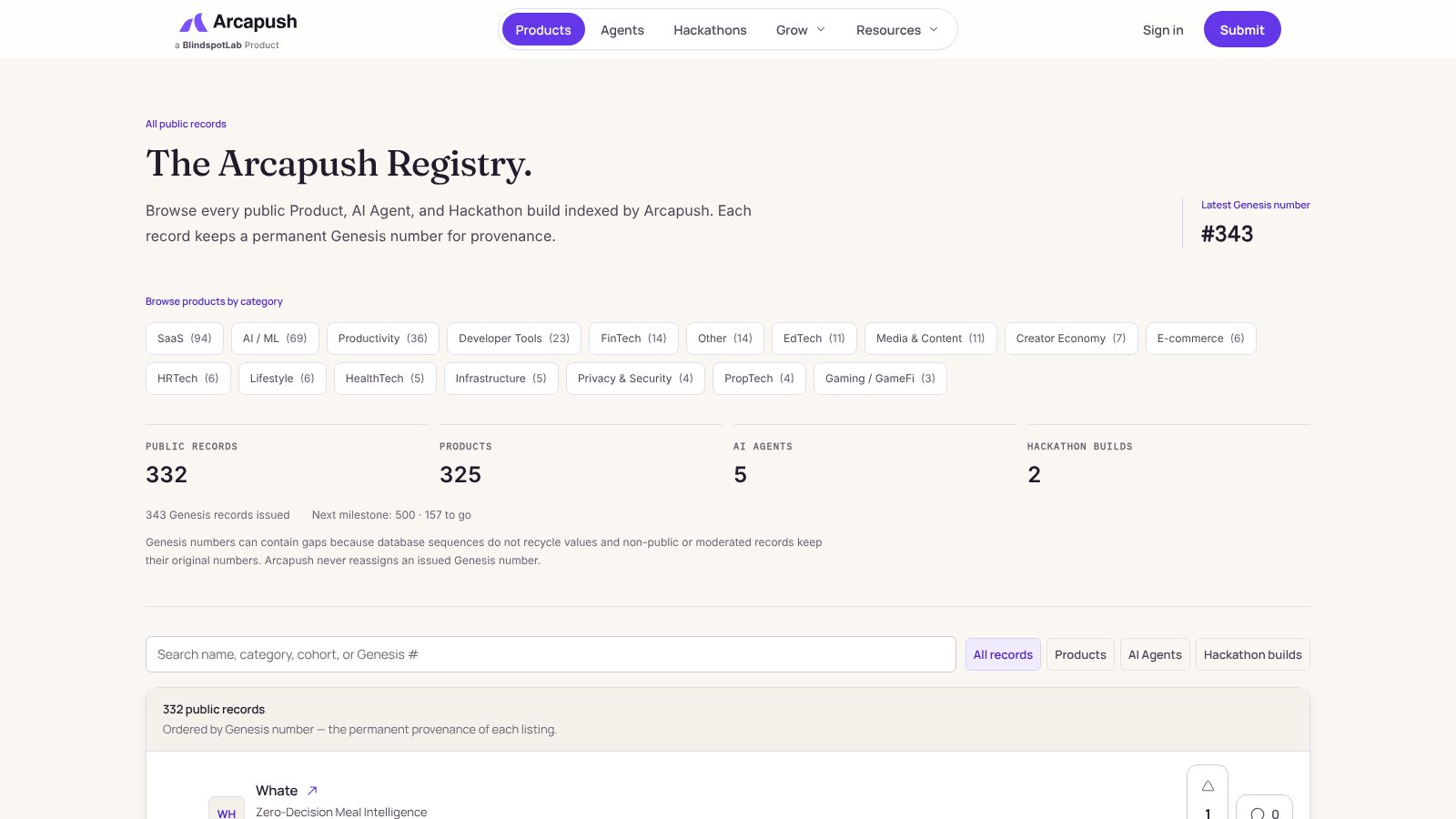
The registry is the index of approved public listings. In 0.4.0 it gained a shareable search: a ?search= query in the URL filters the registry, so a filtered view can be linked, bookmarked or sent to someone. Categories are listed with their counts, so the size of each is visible before you open it.
Every record carries a permanent Genesis number. The registry is ordered by that number and reports three separate figures: public records, Genesis records issued, and the highest number issued. Those differ because numbers are never reassigned and non-public records keep theirs, which the page explains rather than hides.
Redesigned product pages
Listing pages were brought into the same system as the rest of the site.
A record leads with what the build is and who made it, then its media, then the route to the product itself. Outbound links run through a tracked /go route, so the attention a listing sends is counted rather than estimated. Listing pages render the same way on a phone as on a desktop, and each one publishes structured data describing the build.
Community features arrived on these pages in the same release: any listing can be voted on and discussed, with moderation across every listing surface. Votes do not reset daily, so a record keeps its score and its discussion.
Improved submission experience
Submission on the web is a staged form rather than one long page. For a product the stages are basics, description, links, brand and media, builder, and review. AI agents follow the same shape with an optional protocol passport stage in place of the builder stage.
Splitting the form this way keeps validation close to the field that caused it and makes the flow usable on a phone, where a single long form is hardest to complete. Nothing is submitted until the review stage, which shows the whole record before it is sent.
Products enter review before publication. Agents and hackathon builds follow the publishing policy shown during submission. Listing a build does not guarantee promotion, and review time is not fixed.
Submission requires an account, so the page asks you to sign in before a record can be created.
A better builder experience
Builders manage their records from a dashboard that reports what happened after discovery: views, visits, click-through rate and shares for listings they own.
After 0.4.0 shipped, the dashboard sidebar became collapsible and the separate identity screens were combined into one connections page, where GitHub, LinkedIn and X connections live together with CLI session management.
Account handling was tightened in the same period. Paused accounts keep access to their own records while losing the ability to act, and all marketing to them stops.
CLI v0.2.4
The Arcapush CLI is versioned separately from the web application. The current stable release is v0.2.4, and the CLI source lives in its own repository.
Install it with Node.js 22 or later:
npm install -g @blindspotlab/arcapush@0.2.4
arcapush login
Running arcapush opens a guided onboarding with four stages: connect your account, choose what you are shipping, add details and media, then review and submit. Products, AI agents and hackathon builds are all supported.
Useful commands:
arcapush login
arcapush submit
arcapush submit --type agent
arcapush status
arcapush mcp-config
If the browser does not open during login, arcapush login --no-browser prints a URL and a code to use locally. Sessions can be reviewed or revoked from the dashboard.
MCP integration
Arcapush ships a local MCP server inside the CLI, so an MCP-compatible assistant can help prepare a listing.
The reason for building it is narrow. Preparing a good listing means gathering a description, links, categories and media, which is exactly the kind of assembly work an assistant is useful for. Deciding to publish is not.
The flow keeps the human in both of those places. You authenticate in a browser yourself, complete the 18+ declaration yourself, and approve the CLI device yourself. An assistant cannot do any of that for you. When a listing is ready, the host must approve the arcapush_submit tool call, and the tool's own boolean confirmation is explicitly not treated as proof that a person agreed.
After authorising the CLI, add this to an MCP-compatible host and restart it:
{
  "mcpServers": {
    "arcapush": {
      "command": "npx",
      "args": ["-y", "@blindspotlab/arcapush@0.2.4", "mcp"]
    }
  }
}
arcapush mcp-config prints the same configuration for a globally installed command. This runs locally over stdio. There is no hosted MCP URL to paste into a remote-only connector. Local media uploads require an explicit --project-dir path and are sent only after approval.
The current setup instructions are on the documentation page. Never paste tokens or device codes into a chat.
Platform reliability and infrastructure
Production moved to Cloudflare Workers on 8 October 2026, after the 0.4.0 version constant changed. The apex domain, www and the AI agent subdomain are all served from there, and every push to the main branch deploys.
Other work in the same period:
- Turnstile protection on public forms, with a fresh token per request
- Public statistics served from one shared cache with a 15 minute refresh, so an open page never queries the database
- One definition per public number, shared between the homepage and the admin view
- Structured data consolidated into a single connected graph, with the company, founder and brand described once
- Social preview images rendering correctly under Workers
Arcapush does not publish its deployment configuration, environment secrets or security settings, and none appear in this article.
Platform governance and trust
Several policies arrived with the 0.4.0 work.
Arcapush accounts are for people aged 18 and over. The declaration is made in the browser, and the rule is enforced on every route, including the CLI and MCP, so an agent cannot make or change it. Tokens issued before an account was paused are covered by the same policy.
The release also published the company disclosures, the promotion terms, and the email compliance work behind them. Discovery and submission are free. Promotion is selected work with scope agreed beforehand, and there is no public checkout and no pay-to-pin.
Products are reviewed before they are published. A listing is a record, not an endorsement, and it does not guarantee traffic, ranking or coverage. The eligibility page sets out who can hold an account.
The milestone: 300 and counting
At the time this article was published, the Arcapush Registry held 332 public records: 325 products, 5 AI agents and 2 hackathon builds. The highest Genesis number issued was #343.
Two notes on that figure, because these numbers are easy to blur together.
First, "builds indexed" counts products, AI agents and hackathon builds in one total. It is not a product count on its own, which is why the breakdown is given above.
Second, the public statistics on the homepage measure different things and are never added together. Visits counts browsing sessions since recording began in August 2026. Clicks to builds counts outbound clicks from listings. Builders counts people with at least one listed build. Each has a written definition behind the "About these numbers" control on the homepage.
Figures move. These were the values on the day of publication.
What's next for Arcapush
The work ahead is about attention that lasts rather than attention that spikes.
That means continuing to improve how records are found and understood, giving builders a clearer picture of what their listing actually earns, and extending the distribution workflows that do not require sitting in a browser.
None of that is shipped yet, and this section is a statement of priorities rather than a roadmap commitment.
Built for people who ship
If you want to see what is already here, start with the Registry or the wider Discover feed. AI agents have their own surface at agents.arcapush.com, and hackathon builds are at /hackathon.
If you have built something, submit it. It is free, and it works from the browser or the terminal.
If you want the setup details for the CLI and MCP, they are on the documentation page. Earlier release notes are at /updates, and Arcapush is where it all starts.
Shipping is half the work. Being found is the other half.

