
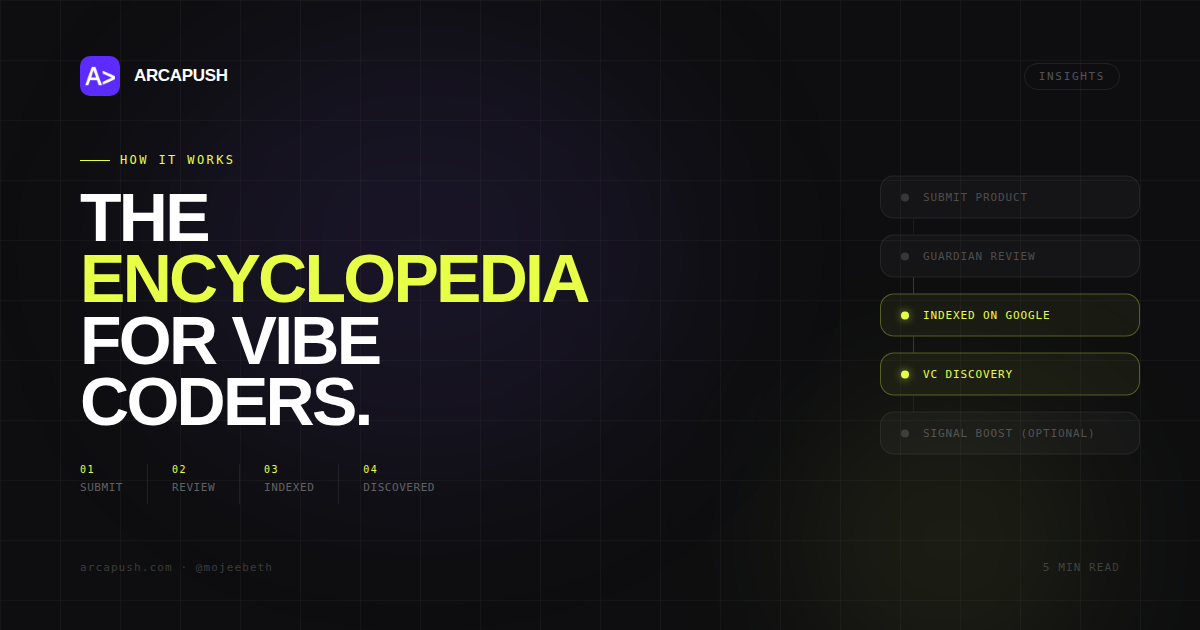
How Arcapush Works in 2026
Arcapush helps products, AI agents, and hackathon projects get discovered, understood, and distributed.
The platform has changed substantially since this article was first published in March 2026. This version describes the current product after the project-media, unified-editor, founder-dashboard, Genesis, and routing phases.
The operating loop
Arcapush is built around a simple loop:
DISCOVER → VISIT → TRACK → DISTRIBUTE → MEASURE → LEARN → DISTRIBUTE BETTER
Discovery is the public layer. Distribution analytics tell builders what attention actually turns into visits and shares. Builder tools make the underlying record richer and easier to maintain.
Three project types
Arcapush currently supports three public project types:
Products
Products live on the primary Arcapush application, with structured project pages and category context.
AI agents
AI agents have a dedicated canonical public surface at agents.arcapush.com. The main-domain legacy /agents routes redirect to the agent subdomain in production, while Arcapush keeps internal path routing for application and analytics compatibility.
Hackathon builds
Hackathon projects can remain discoverable after an event ends, with a structured public record instead of disappearing into a submission archive.
Submission and drafts
Builders submit through arcapush.com/submit.
The submission system supports persistent drafts so a builder can save progress rather than treating the form as one fragile request. The finalization pipeline is designed to be retry-safe and to create the listing through one canonical submission service.
Arcapush does not promise a fixed six-hour approval window. Review time can vary.
Project media
Projects can include richer media rather than relying only on scraped metadata.
Supported project media includes:
- ◆cover images,
- ◆logos,
- ◆screenshots,
- ◆uploaded video,
- ◆YouTube references.
Device uploads use signed storage flows, while YouTube references are normalized for embedding. Media can be managed from the founder editing experience.
One project editor
Owned Products, AI Agents, and Hackathon builds share a unified project-management experience.
The editor groups work into areas such as:
- ◆overview,
- ◆media,
- ◆categories,
- ◆pitch,
- ◆links,
- ◆ownership,
- ◆distribution.
The goal is to give the builder one canonical place to maintain the public project record instead of scattering edits across unrelated forms.
Builder identity and ownership
Arcapush separates who a builder is from whether they have proved control of a specific project.
Builder profiles can carry connected identity signals, while project ownership can be verified through supported proof flows. Ownership verification is not the same thing as editorial approval, and neither is the same thing as Genesis provenance.
Keeping those concepts separate prevents one badge from pretending to prove more than it actually proves.
The Genesis Registry
Every Product, AI Agent, and Hackathon build receives a permanent number from one global Genesis sequence.
The Genesis number is provenance. It records the project's position in Arcapush history and is designed to remain unchanged when the project is edited, reclassified, claimed, or verified.
The global registry at arcapush.com/registry distinguishes between:
- ◆public records currently visible,
- ◆Genesis records issued,
- ◆the highest issued Genesis number.
Those numbers can differ because database sequences can contain gaps and non-public or deleted listings can retain permanent registry tombstones. Genesis numbers are not recycled.
Founder Dashboard
Builders with owned projects get a founder dashboard that acts as a command centre rather than a simple list of submissions.
It includes signals such as:
- ◆portfolio health,
- ◆identity health,
- ◆items needing attention,
- ◆project media/category/deck readiness,
- ◆views,
- ◆visits,
- ◆click-through rate,
- ◆shares,
- ◆distribution shortcuts,
- ◆CLI access management.
Analytics are designed to help a founder understand what happened after discovery, not to manufacture vanity metrics.
Distribution tracking
Arcapush tracks several first-party events around discovery:
- ◆
IMPRESSION— a project card becomes visible, - ◆
VIEW— a detail page loads, - ◆
OUTBOUND_CLICK— a tracked/goroute sends a visitor to the project's destination, - ◆
SHARE— a visitor uses an Arcapush sharing action.
Session and visit identifiers are first-party. Arcapush does not need fingerprinting to produce these project-level analytics.
Promotion is managed work, not self-serve ranking
Normal discovery, submission, and founder analytics for owned listings are free.
Arcapush does offer selected distribution work through arcapush.com/promote, including areas such as:
- ◆launch strategy,
- ◆product positioning,
- ◆content distribution,
- ◆founder storytelling,
- ◆community activation,
- ◆ecosystem campaigns.
There is no public checkout and no current public paid-pinning system. Earlier versions of Arcapush that used crypto/card checkout and public boost tiers are no longer the product described here.
The CLI
Builders who prefer a terminal workflow can use the public Arcapush CLI:
npm install -g @blindspotlab/arcapush
The CLI source is public at github.com/mojeebdev/arcapush-cli. It reads project metadata for supported workflows; it does not upload a builder's source code to Arcapush.
The current stack
Arcapush currently uses Next.js, TypeScript, Prisma, PostgreSQL, NextAuth, and Vercel, with Brevo for email delivery and object storage supporting project media.
Stack details will change over time. This article therefore focuses more heavily on product contracts than framework-version marketing.
What Arcapush does not promise
An Arcapush record does not guarantee:
- ◆Google ranking,
- ◆investor discovery,
- ◆press coverage,
- ◆funding,
- ◆customer acquisition,
- ◆a particular review turnaround.
It provides structured discovery, provenance, ownership signals, project management, distribution surfaces, and measurement. The quality of the project and the work around its distribution still matter.
Get started
Submit a project →
Browse the Genesis Registry →
Explore AI agents →
Request managed distribution →
Update note
This article was fully rewritten on August 20, 2026. Removed claims include the old self-serve payment/boost system, fixed approval-time promises, obsolete stack details, and features that no longer match the current application.